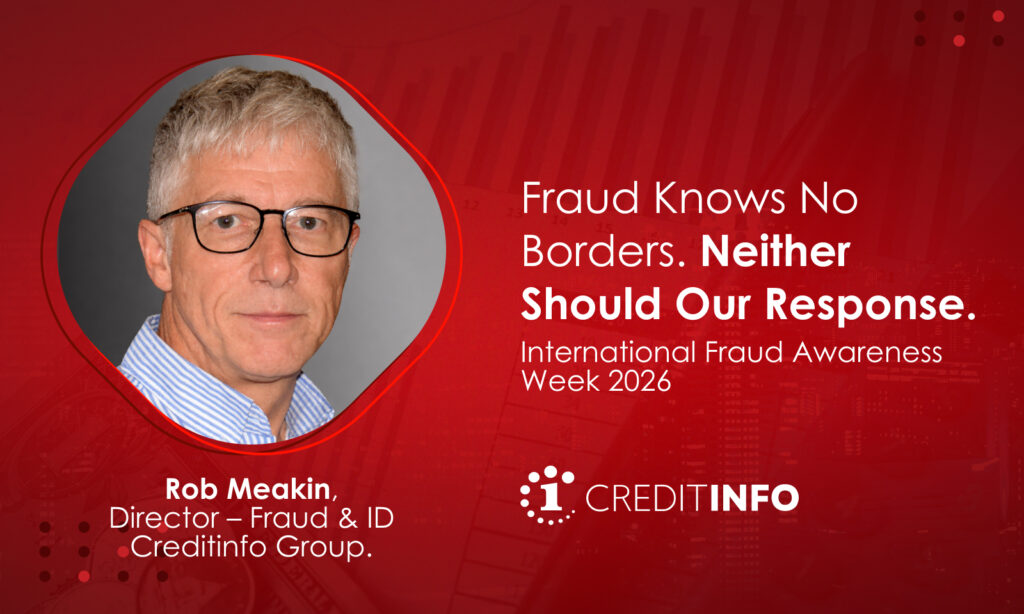
Fraud Knows No Borders. Neither Should Our Response.
Fraud is changing, and it’s changing fast.
From identity theft and account takeovers to increasingly convincing scams, criminals are finding new ways to exploit technology, target individuals and businesses, and move money across borders. What makes this particularly challenging is that fraud rarely happens in isolation anymore. It often overlaps with cybercrime, identity crime and money laundering, making it harder to detect and prevent.
As we mark International Fraud Awareness Week, it’s a good time to reflect on what we’re seeing across the financial industry, what we’re learning and, most importantly, what we can do better together.
Working across different countries gives us a unique perspective at Creditinfo. Every market has its own financial landscape, regulations and level of digital development. But when it comes to fraud, many of the challenges are surprisingly similar.
Banks, lenders, fintechs and other financial institutions are dealing with increasingly sophisticated attempts to steal identities, take over accounts, manipulate transactions and exploit weaknesses in digital systems. And as financial services become more connected, so do the criminals targeting them.
Artificial intelligence and automation are adding another layer of complexity. Tools that help businesses operate faster and more efficiently can also be misused by fraudsters to create convincing fake identities, personalise scams and carry out attacks at scale.
The reality is that fraudsters are constantly adapting, and our approach to prevention needs to evolve just as quickly.
When fraud risks increase, the natural response is often to introduce more checks, more verification steps and tighter controls. But more checks don’t always mean better protection.
For financial institutions, the real challenge is knowing when to act, when to investigate further and when to allow a genuine customer to continue without unnecessary delays. That’s where trusted data and technology can make a real difference.
By bringing together identity information, digital signals, customer behaviour and transaction insights, organisations can build a clearer picture of risk and make better-informed decisions.
This matters because fraud prevention isn’t just about stopping criminals. It’s also about protecting the experience of legitimate customers. A customer applying for a loan, opening an account or making a payment shouldn’t face unnecessary obstacles simply because an institution is trying to manage risk.
The goal is to make it harder for fraudsters to succeed while making it easier for genuine customers to access the financial services they need.
One of the biggest lessons from the changing fraud landscape is that no single organisation can tackle the problem alone.
Criminal networks don’t operate within the boundaries of individual banks, countries or financial systems. They look for gaps, and they take advantage of them. That’s why collaboration matters more than ever.
Financial institutions, regulators, technology providers and industry partners all have a role to play in sharing knowledge, identifying emerging threats and developing more effective ways to protect customers.
We’re also seeing a growing connection between fraud prevention and anti-money laundering efforts. The same suspicious activity that signals potential fraud can sometimes point to wider financial crime. Looking at these risks together, rather than treating them as separate challenges, can help organisations spot warning signs earlier and respond more effectively.
Of course, collaboration must be built on trust, responsible data sharing and strong safeguards. But when organisations work together, they have a much better chance of staying ahead of increasingly connected criminal networks.
At Creditinfo, we work with financial institutions across different markets, helping them use data, analytics and technology to make more confident decisions. We see firsthand how the right information, available at the right time, can help organisations identify risks earlier, protect customers and create safer digital experiences.
But technology alone isn’t the answer. It takes people, expertise, collaboration and a willingness to keep learning as threats evolve.
International Fraud Awareness Week is a reminder that fraud prevention is everyone’s responsibility. Whether we’re developing technology, managing risk, serving customers or shaping financial regulations, we all have a part to play.
And while awareness is an important starting point, what really matters is what we do with that awareness.
Because ultimately, fighting fraud isn’t just about preventing financial losses. It’s about protecting people, building confidence in digital financial services and creating an environment where businesses and communities can thrive.
Rob Meakin,
Director – Fraud & ID Creditinfo Group.