Nova Credit and Creditinfo Bridge Cross-Border Credit Access for Ukrainians

NEW YORK – January 17, 2024 – Nova Credit, the leading cross-border and alternative credit analytics company, has announced a strategic collaboration with Creditinfo, a global service provider for credit information and risk management solutions, to help Ukrainians gain access to the necessary financial services needed to effectively rebuild their lives abroad. The partnership is powered by Nova Credit’s Credit Passport®, the only cross-border credit solution enabling newcomers to access their foreign credit history when applying for financial products in their new home country.
Bridging this critical data gap, Nova Credit and Creditinfo are providing Ukrainian expats and refugees with the tools they need to get started on the right financial footing upon arrival.Since March 2022, the U.S., U.K., and Canada – Nova Credit’s largest partner markets – have seen a combined 840,000 Ukrainians move*, and that number is expected to grow as the Russia-Ukraine War continues. As many will seek permanent residency in these new countries, a lack of credit history will introduce an obstacle to accessing financial services as, historically, new-to-country individuals have had no way to carry over their credit history and financial identity. This presents a challenge for both new arrivals who are looking to re-establish their lives, in addition to lenders who lack the credit data needed to provide their financial services and products to this newcomer population.
With this partnership, credit data from International Bureau of Credit Histories (IBCH) Ukraine (a Creditinfo credit bureau) – one of the three main credit bureaus in Ukraine – can be instantly translated into a local-equivalent credit report and score so that lenders who use the Credit Passport® solution can assess the credit risk of new-to-country Ukrainian applicants. Nova Credit’s partners using the Credit Passport® today include American Express, HSBC, Scotiabank, and Verizon.
“Of the many credit-excluded migrant populations around the world, few are in more dire need of support than the Ukrainian people,” said Misha Esipov, co-founder and CEO of Nova Credit. “Credit access isn’t just a piece of the puzzle; it’s a lifeline for the countless Ukrainians uprooted by the chaos of war. We set out to build this partnership with Creditinfo and IBCH Ukraine from the onset of the war, and our teams have worked hard to enable this integration. Together, we’re using data to bridge a world where everyone, regardless of where they come from, has a fair shot at building a brighter future.”
“We are delighted to partner with Nova Credit to help Ukrainians arriving in the U.S. gain access to financial services and credit checks as they look to settle and rebuild their lives,” said Satrajit Saha, Global CEO of Creditinfo Group. “Among the many challenges facing Ukrainians, is finding ways to access finance. Having a positive credit history is vital to doing many things in the U.S. such as renting a property and securing a job. This is why the information we can provide through our partnership with Nova Credit is so important – it offers the data financial institutions, employers and landlords need to provide basic services to Ukrainians wanting to rebuild their lives.”
The Credit Passport® Ukraine data integration is available for deployment into any credit risk or underwriting process across the U.S., U.K., Canada, U.A.E, and Singapore. To learn more about how to get started with Credit Passport®, visit: www.novacredit.com/business/credit-passport
*Source: 380,000 into the U.S. according to the U.S. Department of Homeland Security, 250,000 into the U.K. according to UNHCR, and 210,000 into Canada under the CUAET program.
Ends.
ABOUT CREDITINFO
Established in 1997 and headquartered in London, UK, Creditinfo is a provider of credit information and risk management solutions worldwide. As one of the fastest-growing companies in its field, Creditinfo facilitates access to finance, through intelligent information, software and decision analytics solutions.
With more than 30 credit bureaus running today, Creditinfo has the most considerable global presence in this field of credit risk management, with a significantly greater footprint than competitors. For decades it has provided business information, risk management and credit bureau solutions to some of the largest lenders, governments and central banks globally to increase financial inclusion and generate economic growth by allowing credit access for SMEs and individuals.
For more information, please visit www.creditinfo.com
ABOUT NOVA CREDIT
Nova Credit is a credit infrastructure and analytics company that enables businesses to grow responsibly by harnessing consumer credit data. The company leverages its unique set of data sources, bank-grade infrastructure and compliance framework, and proprietary credit expertise to help lenders fill the gaps that exist in traditional credit analytics. Nova Credit serves as the bridge between data and credit excellence, providing a comprehensive suite of solutions designed to give lenders across various industries – including finance, fintech, property management, telecom, and automotive – a competitive edge in the open finance era. Its cross-border credit product, Credit Passport®, cash flow underwriting product, Cash Atlas®, and income verification product, Verification of Income, are used by leading organizations like American Express, Verizon, HSBC, SoFi, Scotiabank, and Yardi. Nova Credit is backed by investors including Canapi Ventures, Kleiner Perkins, General Catalyst, and Index Ventures as well as executives from Goldman Sachs, JP Morgan, and Citi. Learn more at https://www.novacredit.com or reach out to connect@novacredit.com.
An excellent Account Information Service is based on the accuracy of the categorization of transactions

In 2021, Creditinfo Estonia received permission from the Financial Supervision Authority to start offering account information services in Estonia, which later expanded to the markets of Latvia and Lithuania. Today, we have been offering the account information service on the market for almost two years. The account information service is based on the PSD2 directive. We have access to the transaction data of customers of banks and financial institutions using a secure data transmission channel and customer consent.
Account information categorization is the first and most trivial account data processing that creates customer value. In addition to the primary value, categorization is also an input for all subsequent, significantly more value-creating services (for example, debt risk assessment). Without categorization, each time finding, analyzing and displaying value from account information becomes too resource-intensive, so the end user would have to wait a relatively long time to get a result from their data.
Unfortunately, categorization is worthless if the accuracy and quality of the categories are low. Of course, every transaction on a bank account is not an input for assessing a person’s credit risk. When determining credit risk, it is critically important that the accuracy of the categorization of transactions required for analysis is as high as possible. This is to prevent credit losses for companies and overdue debts for private individuals, directly affecting both interest groups’ reputations.
The main input from categorization is related to income
Visit creditinfo.ee/en for more information.
Ivo Vallau
Open Banking Product Manager, Ceditinfo Estonia.
Creditinfo appoints Satrajit Saha as new Global CEO

Former CEO of TransUnion Europe – Satrajit Saha – brings his expertise to Creditinfo, planning to drive growth across its credit bureaus globally.
London – 29th November 2023: Creditinfo, a global service provider for credit information and risk management solutions, has today announced the appointment of Satrajit Saha as its Global Chief Executive Officer (CEO). With over 20 years of experience in banking and credit bureau, Satrajit will drive the growth of Creditinfo and the maturity of its credit bureaus globally. He joins the company from TransUnion Europe, where he held the position of CEO for the last five years.
In his role, Satrajit will lead Creditinfo in advancing its strategic initiatives, with a particular focus on promoting financial inclusion worldwide. Drawing on his rich background in the credit information industry, spread across Asia, Africa, and Europe, he will lead the next phase of Creditinfo’s growth on a global level as it strives to become a truly global bureau and the leader for facilitating access to finance in both developed and emerging markets.
As an experienced strategic leader, Satrajit has an impressive reputation in the financial services space. At TransUnion Europe, he led the board of all TransUnion’s European owned entities. Before joining TransUnion Europe, he was Chief Business Officer at TransUnion India, where he was responsible for crafting and executing TransUnion’s CIBIL’s market strategy. He was also Cards Head, Africa Region, at Barclays Bank.
Satrajit Saha, newly appointed Global CEO at Creditinfo said: “I am honored to take on the role of Global CEO at Creditinfo, a company that is at the forefront of promoting financial inclusion. Together with the talented team at Creditinfo, we will continue to leverage innovative data sets and solutions to bridge information gaps and create opportunities to facilitate access to finance for individuals and businesses globally.”
Monty Ismail, Director at Levine Leichtman Capital Partners and Creditinfo Group Board member said: “We are delighted to welcome Satrajit “Satty” Saha as our new Global Chief Executive Officer. He is an accomplished executive with successful leadership experience relevant to our business, including his time as CEO of TransUnion UK. Today marks the beginning of a new chapter for Creditinfo, and we are excited to see Satty, with extensive knowledge of our key markets, take over as CEO. We are looking forward to working with Satty in continuing to expand our global footprint and unlock access to finance for millions of consumers and businesses worldwide. On behalf of the Board of Directors, I would like to thank Paul Randall for his important contribution as CEO. He has been key to our success, and we are all grateful for his leadership and dedication.”
He will begin his new role as Creditinfo CEO on 1st January 2024 and will report directly to the Creditinfo Group Board.
-END-
About Creditinfo
Established in 1997 and headquartered in London, UK, Creditinfo is a provider of credit information and risk management solutions worldwide. As one of the fastest-growing companies in its field, Creditinfo facilitates access to finance, through intelligent information, software and decision analytics solutions.
With more than 30 credit bureaus running today, Creditinfo has the most considerable global presence in this field of credit risk management, with a significantly greater footprint than competitors. For decades it has provided business information, risk management and credit bureau solutions to some of the largest, lenders, governments and central banks globally to increase financial inclusion and generate economic growth by allowing credit access for SMEs and individuals.
For more information, please visit www.creditinfo.com
A Master’s Thesis that highlighted the importance of timely submission of the Annual Report

In May 2023, Creditinfo Eesti announced a prize fund to recognize students who have addressed research questions in the fields of money laundering and sanctions in their research. In cooperation with the COBALT law firm and the representatives of the State Money Laundering Bureau, the evaluation committee chose Victoria Helenurme, a master’s student from the University of Tartu, as the winner for her master’s thesis on the topic “Prediction of deletion from the business register due to non-submission of the annual financial report using the example of Estonian companies”.
Victoria Helenurm is from Tallinn and graduated cum laude from the University of Tartu, majoring in Marketing & Financial Management. Today, she works as a financial controller in a company offering energy-saving indoor climate and renewable energy solutions and sees her future in business.

We had an interview with her on the journey of her thesis topic:
The topic of your thesis was “Prediction of deletion from the business register due to non-submission of the annual financial report using the example of Estonian companies” – how did you arrive at this topic?
At the beginning of the summer of 2022, discussions began with people who eventually became my thesis supervisors. My main desire was to write a paper on a current topic in society. This year, the Estonian state penalties for not submitting the annual report became harsher, and in cooperation with my supervisors, we saw that there is a public interest in this area of research and also sufficient data for research.
Why was this topic worth researching?
If, as a person, we take a loan, for example, we are understanding the obligations that come with taking a loan. For me, founding a company or being on its board is a somewhat similar responsibility – as a manager, we have assumed the responsibility, among other things, to report on the progress of our company’s business to the public.
Unfortunately, while we are mostly exemplary in servicing loans, tens of thousands of Estonian companies fail to submit their annual reports on time.
I cannot say whether this difference is due to, among other things, the fact that the penalties for not submitting the annual report have been relatively lenient. But it is certainly worthwhile for us to become more aware that such behavior is problematic.
After all the state of our countries businesses is based largely according to the data of the Business Register. If we have thousands of active companies that do not fulfill their reporting obligations, the financial forecasts, risk analyses, business decisions, etc. of the state, lenders and other parties will suffer in its quality.
The submission deadline (6 months after the end of the financial year) is a very lenient deadline. The business landscape is more and more unpredictable, so the knowledge of the previous year’s business results that arrives half a year later is already outdated. As is typical of our e-government, we would expect that at least certain types of companies could be assigned a much earlier submission obligation to help update our economic data.
What facts became clearer as part of the research?
In my research, I tried to find an answer to the question of whether the deregistration of a company can be predicted purely by looking at how the company’s management has cared about the obligation to submit an annual report in its previous business life.
The Estonian financial world is very much a believer in financial ratios when assessing the business health of a company. I tried to see if it is possible to convincingly assess the business risk of deleting the company by completely setting aside the financial statement.
The studied dataset also proved this – a significantly more accurate forecasting method than financial ratios (prediction accuracy approx. 63%) was the observation of the past behavior of board members (prediction accuracy almost 82%). It can be said that if there is a member of the board of the company who has either delayed or failed to submit the financial year report in previous companies, it is a very clear business risk, which indicates the risk of deletion of the company in question.
How could this research topic be continued?
Although I myself rather do not plan to continue my studies in a doctoral program, I definitely see possibilities for expanding this research topic. The obtained research results could certainly be compared with our neighboring countries – to assess whether in Latvia, Lithuania, Finland, etc. there are similar relationships between corporate delisting and board members’ past due diligence.
Another immediate opportunity for investigation is provided by the amendments to the law that entered into force this year, which toughened the penalties for failure to submit an annual report, among other things. Repeating this research in 5+ years would give an idea of whether business behavior has improved in terms of reporting obligations.
We were very pleased with Victoria’s research, as her research clearly connected with the general theme of our competition – the data of the Business Register and national registers in general are the main factors when applying the KYC principle. Financial data from the company that is not submitted on time or is completely missing, is a clear danger signal when investigating the background of your business partner.
When it comes to risk management – both when creating a customer relationship and during the existence of a customer relationship, up-to-date data from the business register is very necessary. Does the company actually operate; whether the data there (especially the field of activity and financial data) are correct (especially when it comes to the application of enhanced due diligence measures). The given data helps to understand the customer’s activity profile.
If the client does not submit annual reports, it is clear that it may be a riskier client, and this should be taken into account when establishing or monitoring a business relationship in order to mitigate the risk.
Urmas Pai – KYC&Fraud Global Product Manager, Head of the evaluation committee
Creditinfo Estonia
Creditinfo’s Account Information Service Product

In the spring of 2021, the Estonian Financial Supervision Authority authorized Creditinfo Estonia to offer Account Information Service in the Estonian market. In the autumn of 2021, the Estonian Financial Supervision Authority also granted the authorization to provide Account Information Service to the Latvian and Lithuanian markets. This act added to our product portfolio a new, exciting product that benefits our customers in the short and long run. As of today, we have had the Account Information Service in our cross-Baltic product portfolio for two years.
About the Account Information Service
The opportunity to provide Account Information Service emerged when the European Union (EU) Parliament and the EU Council adopted a new directive regulating payment services in the EU internal market on November 25, 2015 (PSD2), which emphasized the expansion of open banking in Europe.
Open Banking refers to provide third-party financial service providers open access to transactional data of bank and financial institution customers, using secure data transmission channels and customer consent.
The Account Information Service is a part of the Open Banking initiative, defined as an online service where the service user (customer) is identified and authenticated via strong identification and authentification means. The service itself means transmitting customer’s bank account data through a secure channel to third party from whom the customer wishes to apply a credit product.
How does Creditinfo provide the Account Information Service?
Using Creditinfo Estonia’s solution, both individuals, which is regulated by the aforementioned payment service directive, and companies can transmit their account information to third parties.
Beside financial sector the possibilities of the Account Information Service can be successfully used in application processes in various sectors. Previously mentioned customer consent is obviously obligatory.
Different sectors that can benefit from account information:
- Public sector companies that provide subsidies to individuals and businesses, where the information in the account details creates significant value when determining subsidies;
- Insurance sector companies, which can use behavioral information from the bank account for determining insurance premiums or simplifying the insurance incident evidence burden;
- Other sectors where value from account information help to create better personalized offers for their products and services.
The strength of our Account Information Service is categorization.
The greatest value of the Account Information Service provided by Creditinfo Estonia comes from categorizing account transactions, which our clients (data recipients) can conveniently use in their business decisions.
Categorization is a solution that can and should be continuously improved over time. Precise and detailed categorization is a top priority for Creditinfo Estonia’s Account Information Service.
The data from the Account Information Service serves also as an input for our Account Information Service Report. The report helps to make more informed business decisions both internally and towards our client’s customers. The report highlights all the key ratios, indicators, “green and red flags” and much more that can be extracted from account information.
The report is designed in a way that can be customized to meet the client’s needs, which make it a tool for everyday business decisions.
More information about the service: https://creditinfo.ee/en/avoid-debts/psd2/
Credit Bureaus and why they will remain important in the years to come

As the financial industry continues to evolve, credit bureaus need to continue to adapt. There are many compelling reasons why credit bureaus will continue to play a vital role in the future of lending and credit. In this blog, we’ll explore the benefits of credit bureaus and why they will remain important in the years to come.
1. Efficient and standardized credit data
Credit bureaus provide an efficient and standardized way to collect and store credit data. This allows lenders to quickly access the credit history and credit scores of potential borrowers, which is essential for making informed lending decisions. Without credit bureaus, lenders would need to spend more time and resources gathering credit data from various sources, which would slow down the lending process.
2. More accurate credit models
Credit bureaus are constantly refining their credit models to improve accuracy and predictiveness. By analysing large amounts of credit data, credit bureaus can develop more sophisticated credit models that consider a wide range of factors, such as payment histories, outstanding debts, and length of credit history. These models provide lenders with a more accurate picture of a borrower’s creditworthiness, helping to reduce the risk of defaults and delinquencies.
3. Increased access to credit
Credit bureaus play a critical role in expanding access to credit. By providing lenders with access to credit data, credit bureaus make it easier for individuals and businesses to obtain loans and credit cards. This is particularly important for people with limited credit histories or who have had past credit problems, as credit bureaus provide lenders with a way to evaluate these borrowers’ creditworthiness.
4. Protection against fraud and identity theft
Credit bureaus also play a key role in protecting consumers against fraud and identity theft. By monitoring credit reports for suspicious activity, credit bureaus can help detect and prevent fraudulent activity. Additionally, credit freezes and fraud alerts can be placed on credit reports to prevent unauthorized access to credit data.
5. Continued relevance in a changing industry
While the financial industry is evolving rapidly, credit bureaus will continue to be relevant in the future. As new technologies and data sources emerge, credit bureaus will adapt and incorporate these changes into their credit models. Additionally, credit bureaus will likely face increased competition from fintech startups and other companies, which will push them to innovate and improve their offerings.
In conclusion, credit bureaus are essential to the lending and credit industry. By providing lenders with access to credit data, credit bureaus make it easier for individuals and businesses to obtain loans and credit cards. Additionally, credit bureaus play a critical role in expanding access to credit, protecting consumers against fraud and identity theft, and adapting to a changing industry. As the financial industry continues to evolve, credit bureaus will remain a vital part of the lending and credit ecosystem.
Gary Brown,
Head of Commercial Development, Creditinfo Group.
Creditinfo Kenya partners with Letshego Kenya to launch lending app

Letshego Kenya launches “Letsgo Cash” in partnership with Creditinfo Kenya to take financial inclusion to a higher level.
· Minimum loan amount of KES 1,000 and a maximum of KES 100,000 and a loan repayment period of 30 days.
· LetsGo Cash increases access and supports customers who need quick and easy access to funds for emergency purposes.
· LetsGo Cash supports digital financial inclusion and enables the underserved and informal sector players to build their own credit records.
Nairobi, Kenya, 3rd May 2023 – Letshego Kenya Limited, a subsidiary of Letshego Holdings Limited (Letshego Group), has partnered with Creditinfo Kenya to launch LetsGo Cash, a self-service and short-term instant loan that gives customers access to KES 1,000 up to KES 100,000.
LetsGo Cash is payable in 30 days and geared towards consumers who need quick and easy access to funds for emergency purposes, including family emergencies, medical needs, home repairs, car breakdowns or funds to support entrepreneurs and small businesses. Creditinfo Kenya’s team brings decades of experience and practical knowledge in credit risk management to support the delivery of LetsGo Cash.
Letshego Kenya’s Chief Executive Officer, Adam Kasaine said: “LetsGo Cash is another way we are increasing access to product funds for more Kenyans. This is inclusive finance in action – it’s quick and hassle-free cash at a competitive price, accessible via your phone or web.”
The innovative LetsGo Cash is a potential game-changer, as it is accessible anytime, anywhere and is more competitive than traditional short-term cash advance providers, providing customers with immediate financial relief and the opportunity to participate in the digital economy in a sustainable and responsible manner.
Creditinfo’s Regional Manager for East Africa, Kamau Kunyiha added: “Creditinfo is proud to support LetsGo Cash assist customers who need quick and easy access to emergency funds the most, while also helping the underserved to build their own credit scores at the same time. Customers’ applications are submitted with a few swipes on a mobile phone, and the time to cash can be as short as a few minutes.”
LetsGo Cash provides a convenient, safe and affordable financial service to the underserved and informal sector players thereby helping to increase financial inclusion. It also helps them build their own credit record, since the better they manage their loan, the better their credit record, and the more cash they have access to going forward. This ensures that more people can access the service, including first-time borrowers who can now enjoy the benefits of a secure, regulated lending solution. Once approved, the money is disbursed directly into the customer’s mobile wallet. It can then be used as the customer desires, including for emergencies, such as purchasing prepaid electricity and water, paying bills, or sending money to friends and family.
LetsGo Cash can be accessed on Letshego’s LetsGo Digital Mall and downloadable via Android and Apple Play Store, or with one click, clicking on www.letsgo.letshego.com as well as via the USSD *435# on their mobile phone.
-ENDS-
NOTES TO EDITORS:
About Letshego Kenya Limited
Letshego Kenya Limited is the largest credit-only microfinance institution in Kenya and a licensed financial services provider in Kenya, providing loans to individuals across both the public and private sectors, as well as supporting Micro and Small Entrepreneurs (MSE). Since the conclusion of the successful acquisition by Letshego Holdings Ltd in February 2012, Micro Africa Group became a wholly owned subsidiary of Botswana-based Letshego Holdings Limited – an inclusive finance group with more than 21 years’ experience in Africa, and a current footprint of 11 Sub-Saharan Markets. Its contribution to the group has been to leverage the microfinance banking competencies and existing customer base, expand Letshego’s geographic coverage, and diversify its solution offering.
The company is founded on, and continues to strive towards, the principle of finding the most effective way to implement microfinance banking in an African context and transform the livelihoods of customers who carry out viable economic activity. Letshego Kenya Limited has a staff compliment of over 150 employees, spread across 25 branches. The company provides loans to over 20,000 customers who enjoy an expanded access through strategic partnerships, innovative technology and digital delivery channels. For more information on Letshego, please visit www.letshego.com/kenya
About Creditinfo
Established in 1997 and headquartered in London, UK, Creditinfo is a provider of credit information and risk management solutions worldwide. As one of the fastest-growing companies in its field, Creditinfo facilitates access to finance, through intelligent information, software and decision analytics solutions.
With more than 30 credit bureaus running today, Creditinfo has the most considerable global presence in the field of credit risk management. For decades it has provided business information, risk management and credit bureau solutions to some of the largest, lenders, governments and central banks globally to increase financial inclusion and generate economic growth by allowing credit access for SMEs and individuals.
For more information on Creditinfo, please visit www.creditinfo.com
The Role of Artificial Intelligence and Machine Learning in Credit Scoring

Executive Summary
The use of artificial intelligence (AI) and machine learning (ML) in credit scoring is revolutionizing the lending industry. By leveraging vast amounts of data and advanced algorithms, lenders are able to more accurately predict credit risk, improve operational efficiency, and expand access to credit for underbanked individuals and small businesses. This white paper explores the benefits and challenges of AI and ML credit scoring, and provides guidance for lenders on how to successfully integrate these technologies into their lending processes.
Introduction
Traditional credit scoring models rely on a limited set of data points, such as payment history, outstanding debt, and length of credit history, to assess creditworthiness. These models are effective for many borrowers, but they can be limiting for individuals with thin credit files or non-traditional sources of income. AI and ML credit scoring models, on the other hand, can analyze a vast array of data points, including non-traditional data sources, to develop a more accurate and comprehensive picture of a borrower’s creditworthiness.
Benefits of AI and ML Credit Scoring:
1. Improved accuracy: AI and ML algorithms can analyze a wide range of data points, including non-traditional data sources such as social media activity and utility bill payments, to develop a more accurate picture of a borrower’s creditworthiness. This can result in more accurate credit scores and better loan decisions.
2. Expanded access to credit: Traditional credit scoring models can be limiting for individuals with thin credit files or non-traditional sources of income. By analyzing a broader range of data points, AI and ML credit scoring models can expand access to credit for underbanked individuals and small businesses.
3. Increased efficiency: AI and ML credit scoring models can automate many aspects of the lending process, reducing the need for manual underwriting and improving operational efficiency. This can result in faster loan decisions and a better borrower experience.
Challenges of AI and ML Credit Scoring:
1. Data privacy and security: As AI and ML credit scoring models rely on vast amounts of data, data privacy and security are critical concerns. Lenders must ensure that they are collecting and using data in compliance with applicable laws and regulations, and that they have robust cybersecurity measures in place to protect sensitive borrower data.
2. Bias and discrimination: AI and ML algorithms are only as good as the data they are trained on, and if that data is biased, the algorithms can perpetuate that bias. Lenders must be mindful of potential biases in their data and take steps to mitigate any potential discrimination in their lending decisions.
3. Explainability: AI and ML algorithms can be complex and difficult to interpret, which can make it challenging for lenders to explain their lending decisions to borrowers. Lenders must be able to provide clear explanations of their credit scoring models and lending decisions to borrowers.
Conclusion
AI and ML credit scoring has the potential to revolutionize the lending industry, providing more accurate credit scores, expanding access to credit, and improving operational efficiency. However, lenders must be mindful of the potential challenges, including data privacy and security, bias and discrimination, and explainability, and take steps to mitigate these risks. By investing in AI and ML technologies and developing robust risk management practices, lenders can successfully integrate these technologies into their lending processes and provide better loan decisions and a better borrower experience.
Samuel White
Director of Direct Marekts, Creditinfo Group.
“Vera”, Creditinfo’s ESG platform, now available for customers in Iceland

Environmental, social, and governance (ESG) factors are increasingly becoming a key consideration for investors, stakeholders, and companies. These factors help measure the sustainability and societal impact of a business, and ESG data is crucial for decision-making in the investment and corporate world. However, the availability, quality, and accessibility of ESG data have been major challenges, making it difficult to obtain accurate and reliable insights. This is increasingly becoming a problem for small and medium sized businesses that do not have the resources available to access and produce accurate and reliable ESG data.
To address this growing need for ESG data services Creditinfo Iceland recently launched Vera, a new ESG data platform, for customers in Iceland. With Vera companies can access data about their customers and/or suppliers in an accessible way. The platform contains diverse sustainability information for all active companies in Iceland including data directly reported by companies as well as external sources such as media coverage, judicial information, and supply chain operations. Companies can easily update their own sustainability information through MyCreditinfo to ensure an accurate portrayal of information such as emissions, ESG ratings, and other relevant data.
What are the features Vera has to offer?
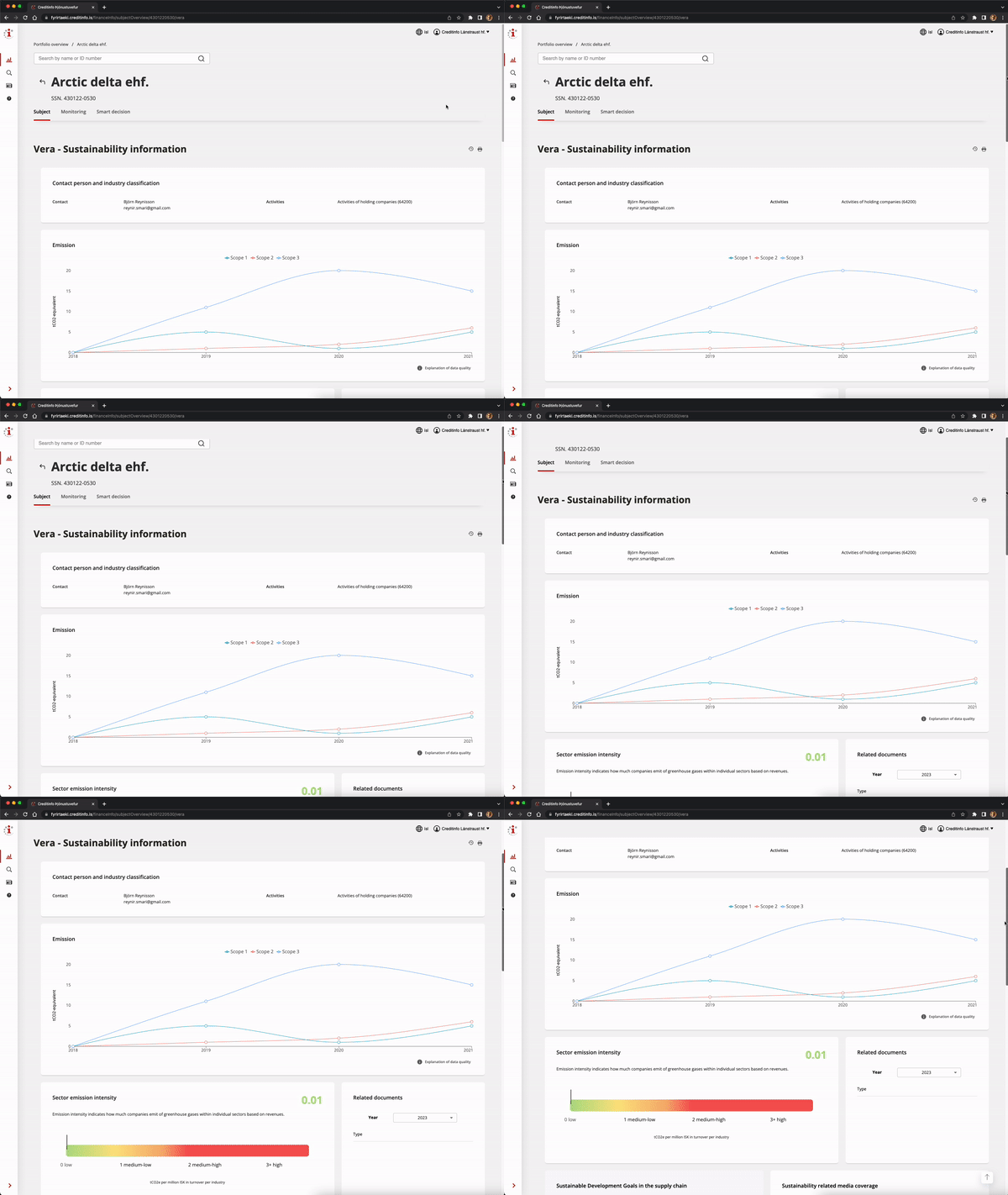
- Who can update sustainability information?
One of Vera characteristics is that much the data can be updated to increase accuracy. If a company has a dedicated in-house sustainability officer, this person can be given access to Vera to update its info. This is done through MyCreditinfo where anyone inside the company with edit access can forward the access to a relevant employee. The sustainability officer can then provide the needed input.
- Contact person
Sometimes it is difficult to reach the relevant person within companies regarding sustainability. This can happen during supplier assessments or during other processes where sustainability data is needed. It can also be time consuming to figure out who is responsible for this subject within companies. Vera helps with this process by offering companies to clarify who is the responsible person for sustainability related matters. This makes all communications easier and data flow quicker.
- Greenhouse gas emissions
Most companies are accountable for greenhouse gas emissions, either directly or indirectly. Some companies know how much is emitted and where. Vera can estimate the greenhouse gas emissions from company operations if she knows the industry companies operate in and their revenue. This data must be in place in order for Vera to run its calculations. If companies know however their emissions, they can update their profile to provide better information to the market.
- Emission intensity
Absolute greenhouse gas emissions tell a certain story regarding company operations. However, companies can emit the same amount of greenhouse gases while their size may differ. So understanding how much is emitted per revenue provides a better understanding of the sector. Emission intensity of the sector is therefore also a very relevant metric. Vera provides its users with an overview of the carbon intensity of the sector companies operate in. Sector emission intensity can initiate an interesting conversation between a lender/investor and the company where the company may want to demonstrate a better performance than the sector as a whole. Vera provides the sector carbon intensity on a scale which is easy to read and understand.
- Sustainability risks and opportunities
Sustainability risks vary between sectors. Material sustainability factors are those who may have financial implications on companies if mismanaged. Sustainability accounting standards board (SASB) which is now a part of the IFRS has defined which sustainability factors are material within sectors and why. Such an overview is important for companies in order to manage material factors instead of using resources to provide data on non-material factors.
Vera uses data from SASB to provide its users with an overview of material factors for individual companies and if the factors are considered climate risks. If a sustainability risk is classified as climate risk, Vera indicates the type of climate risk. This can be physical or transitional. Physical risks appear for example through extreme weather, ocean acidification etc. Transition risks appear through policy and legal risks. Vera provides an understanding regarding which sustainability risks companies are exposed to in a convenient manner.
- Sustainability in the value chain
Using public data it is possible to map out the international supply chain of sectors. Vera provides such overview but is clear regarding the pitfalls of the data as the sector does not represent individual companies. Companies can therefore update their supply chain data. By updating the data in Vera, companies gain a deeper insight into various sustainability related matter in their value chain.
Users of Vera can click on the value chain countries and redirect to the UN SDG website where even more detailed data is provided. In this way, the users of Vera and the reporting companies get a much better overview of the possible risk factors in the supply chain.
- Sustainability media information
Creditinfo maintains a media monitoring service in many of its markets. Using the data from Creditinfo, it is possible to monitor ESG related news articles involving individual companies. The ESG media monitor only monitors ESG related articles. Vera therefore utilizes the media quite effectively as a watchdog. Vera also provides ESG related media coverage regarding companies within the same sector.
- Sustainability media information in the supply chain
Vera understands which countries the sector mostly does business with. Using this data, Vera can monitor ESG related matters in the countries the company mostly does business with. If a company provides better data regarding its value chain, they have the possibility to understand better on a macro level the operating conditions in those countries. Such data can be used for decision making and supplier assessments.
- Sustainability documents
Companies often publish reports and documents related to sustainability. This data is often dispersed around their website and is time consuming to maintain in a single place. Companies may also have various certifications in place which they may want to put forward. Such reports can be uploaded to Vera, which makes their access easier. If a company does not upload its reports to Vera, Creditinfo staff manually gathers the data and uploads to Vera.
- Court cases
Vera provides an overview of court cases the company appears in for all court levels. It is possible to see the case abstract only or navigate to the official court document online. Vera also shows court cases for parent companies and subsidiaries. The ratio of ownership has to be 10% or more in both directions for Vera to show the cases. Vera therefore provides a better insight into related cases than the courts themselves.
- Diversity information
Diversity in management and staff is an important component of successful companies. Studies have shown that gender diversity in staff has a positive impact on companies. Vera offers information about gender ratios for employees, board members and executives for a company. This information can be updated via MyCreditinfo.
For more information visit www.creditinfo.com
Creditinfo Partners With VisionFund International to Provide Analytics and Automation Solutions

Creditinfo Group, the leading global service provider for credit information and risk management solutions, today announces a multi-market partnership with VisionFund International to provide analytics and automation solutions throughout their global Microfinance Network.
Creditinfo’s credit risk analytics and automation solution will help VisionFund to expand their customer base whilst controlling costs. This will enable VisionFund to increase financial inclusion and improve economic conditions for lower income clients around the world.
Creditinfo will draw upon its global and regional experts to support the implementation of these solutions over a three-year period. Initially, Creditinfo will provide its solutions to six of VisionFund’s markets with a view to extending them to additional VisionFund’s markets in due course.
Paul Randall, CEO at Creditinfo said: “We are delighted to have been selected by VisionFund International to provide IDM Decision Automation solution to their global network of MFIs (Microfinance institutions). Our understanding and experience of working across over 20 markets is strongly aligned with VisionFund’s experience as one of the largest multinational networks of MFIs with its operations spanning 28 countries and reaching over 1 million active customers. We are excited about the journey ahead and helping VisionFund realize its goal of enabling clients to grow their livelihoods and secure their futures.”
Karen Lewin, Director of Credit Risk at Vision Fund International said: “With Creditinfo’s solution, we will increase our outreach, and improve both lending efficiency and our credit risk assessment capabilities, to better meet the needs of all our customers. Creditinfo’s team of global and local experts will provide us with the level of support we need to achieve these goals and increase financial inclusion in the markets where we operate.”
For information visit www.creditinfo.com