Travel agencies in Lithuania are slowly rising from the ashes
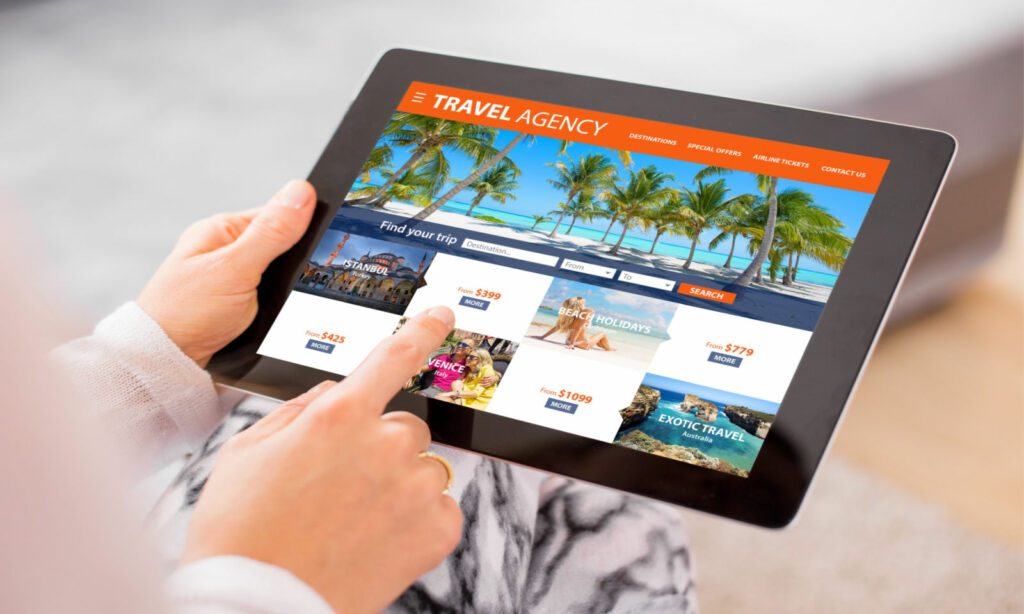
Revenues doubled in a year but remained three times lower than before the pandemic.
Vilnius, Lithuania, 24/01/2023. Travel agencies in Lithuania that declared their income in 2021 earned almost twice as much as in the previous year. However, compared to income in 2019, they earned almost three times less, according to an analysis carried out by the credit bureau Creditinfo Lietuva. Almost 100 tourism companies were loss-making. With the increase in travel flows, the number of debts increases and their average size grows.
There are currently 783 companies in Lithuania for which tour organisation is the main activity. In 2021, travel agencies declaring revenues collectively earned more than €171 million, almost double (82%) the pandemic year 2020 (~€94 million). However, travel agencies are still a long way from a real recovery – for example, in 2019, their revenues were almost €474 million, but fell more than fivefold in the aftermath of the pandemic.
According to 2021 data, the largest annual revenue was earned by the following companies: Novaturas (€108,995 million), Tez Tour (~€60 million), Itaka Lietuva (€12.5 million), Coral Travel Lithuania (€9.5 million), Kidy Tour (€8.9 million), Estravel Vilnius (€6.3 million), Estekspress (€4 million), Traveldeals LT (€4 million), Glotera (€3.6 million) and ZIP Travel (€2.9 million).
The top ten most profitable travel agencies are Novaturas (€909 thousand), Baltic Tours Group (€633 thousand), Vestekspress (€530 thousand), Glotera (€336 thousand), Traveldeals LT (€307 thousand), Baltic Clipper (€288 thousand), Baltic Travel Service (€271 thousand), TEZ Tour (€215 thousand), Estravel Vilnius (€158 thousand), Riviera Tours (€148 thousand) and ZIP Travel (€123 thousand).
Staff numbers shrink by a quarter
In total, travel agencies currently employ almost 2,000 employees (1,850). While the number of enterprises has remained almost constant over the past few years (776 in 2019, 787 in 2021), the number of employees has fallen by almost a quarter since 2019, from 2,426 to 1,850.
Travel agencies are more often headed by women, accounting for almost 56% of all managers. The average age of a travel agency manager is 49 years and the average age of a travel agency is over 15 years.
In the travel sector, men’s salaries are higher than women’s – as of November 2022, the average salary for men was €2,659 per month, while for women it was €2,014 per month. At the start of 2022, the average salary for women was €2,053 per month and for men was €2,364 per month.
State support has prevented more bankruptcies
Since 2004, a total of 94 travel agencies have gone bankrupt in Lithuania, with the highest number of bankruptcies recorded in 2009 (10) and in 2015 (12). In 2022, there were 5 travel agency bankruptcies, while there were 3 in 2021 and 4 in 2019. No travel agency bankruptcy was recorded in pandemic year 2020.
“The travel sector was one of the hardest hit by the pandemic, along with hotels and restaurants. During the pandemic, when revenues from tour operators dropped fivefold, it was state support that saved the sector from bankruptcy,” explains Aurimas Kačinskas. But the challenges of the pandemic were replaced last year by new challenges – the war in Ukraine and the sanctions imposed on Russia have exacerbated the energy crisis, fuel prices have risen and many travel routes have been disrupted. The slower-than-expected recovery of the air transport sector, with a sharp increase in fares, is having a negative impact on the business of tour operators, preventing them from recovering faster.
According to the head of the credit bureau, it was state support that determined the stability of the number of enterprises and the discipline of submitting financial statements – compared to other sectors, only 90 travel agencies did not submit their financial statements for 2021, making them ineligible for state support.
However, a risk analysis of travel agencies shows that there have been both positive and worrying signs in the recent period. For example, as of January this year, 9% of companies were in the high and highest classes of bankruptcy, compared with 12% a year ago. In terms of delayed payments, 17% of companies are currently in the high and highest risk classes, down from 21% last year.
Compared to 2020 and 2021, the recent increase in debt is slightly higher and the average amount of debt per person is growing. At present, 306 debts have been registered in the credit bureau system, amounting to more than €349 thousand, with an average debt of €1,141. A year ago, the number of debts was 316, amounting to €351 thousand, with an average debt of €1,112. In January 2020, 255 debts amounting to €203 thousand were registered, with an average debt of €798. 335 travel agencies mostly owe money to Sodra (€3 million). The debt of 158 travel agencies to telecommunications companies amounts to €222 thousand. 8 travel agencies owe €74 thousand to financial companies.
“The tour operator business is recovering, but revenue growth is slower than expected in the wake of the pandemic due to the many geopolitical and economic shocks around the world. The tourism sector is currently encompassed by a number of risks, so it is advisable to keep a close eye on the changing financial indicators of partners organising the trips,” concludes the head of the credit bureau.
More information:
Aurimas Kačinskas, CEO of Creditinfo Lithuania (aurimas.kacinskas@creditinfo.com)
The fintech movement in the banking industry
Is fintech an enabler or disruptor in the banking industry? Fintech the new technology that improves and digitalizes the delivery and services of the banking industry. These solutions can include software helping connect with customers, businesses, and banks through agile processes to manage financial services better. Or better use of data to offer a more personalized and customer centric offering.
The lending landscape has gone through some major changes in recent years, and this shift does not appear to be slowing down. Based on the latest information from the World Bank, about 76% of adults have a bank or mobile account, this is up from 51% in just over a decade. The rise of mobile money solutions, which allow users to turn their smartphones in digital wallets and use it to pay for services, have played an important role tapping into the unbanked segment and supporting this improvement.
Fintechs are realizing the opportunities to disrupt the challenges faced by traditional banking and offering new solutions that better suit the needs of customers and businesses. By embracing technology, fintech companies can collect and store more data on customers so they can offer personalized solutions with greater choice of products. Unlike traditional banks, fintechs can move with speed and deliver digital solutions improving the user experience.
The increase in fintech players has increased competition between traditional banks and fintechs. Traditional banks are paving the way to collaborate with fintechs while others are implementing teams to focus on in-house projects. Older generation customers may value trust over the latest trends and will therefore remain loyal customers to traditional banks., However, younger generations will demand more and swifter solutions because that is what they are familiar with. Traditional banks embracing fintech solutions will see them provide the flexible solutions that customers are looking for.
One of the biggest reason the banking industry has adapted to fintechs, is due to their ability to connect with customers 24/7 through an omnichannel approach. This not only increases customer reach and convenience but also allows banks not to rely solely on customers visiting a branch.
It is expected that we will continue to see changes in the banking industry for years to come, the speed of change will depend on how much and how fast customers continue to adapt to fintech solutions. It’s clear, traditional banks are no longer the monopoly in this industry, with more digital banks, neo– banks and new players such as telcos and payment companies entering the lending landscape. Nobody is expecting the traditional banks to be replaced but it is likely that banks and fintechs partnering with one another will allow the traditional banks to enhance technologies and by coming together both the fintechs and the banks can benefit in this highly competitive market.
Samuel White,
Direct Markets Director, Creditinfo Group.
Paving the way for a brighter future through SME lending
Developing modern solutions and removing barriers, paves the way for a brighter future through SME lending
SMEs (Small and Medium-sized Enterprises) are known as one of the biggest business sectors in each economy, being important contributors to job creation and global economic development. They create more than 50% of employment worldwide.
SMEs have gained importance in developing economies. Although SMEs have some weaknesses, they are less affected by economic crises due to their flexibility and ability to keep up with changing conditions. SMEs are vital establishments to create an effective innovation ecosystemThis is shown by recent studies that SME’s can contribute to over 55% of GDP and over 50% of total employment.
SMEs can find it increasingly difficult to borrow money from traditional banks because of strict requirements. It is often seen that SMEs are riskier than large institutions as it is difficult for banks to evaluate them in the same way since they often do not have solid accounting systems. This difficulty in assessing their creditworthiness often impacts the bank’s ability to provide affordable credit. As a result, many SMEs are forced to look at alternative solutions such as expensive credit lines charging high interest rates or offering costly collateral. Neither of these options are sustainable for small businesses.
SMEs need fast decisions and a more agile, digital approach. This is where Creditinfo and local Fintechs are working in collaboration to support the sector. Together, we specialize in using technology to quickly assess each SME’s entire data footprint and then provide tailored financial solutions. Based on our experience in Africa, we can assess the credit risk an SME poses by using real-time data from multiple sources, including e-wallets, credit bureaus and credit scores. The traditional method, consisting of manual processes and hard copies, is now an outdated approach in the digital world.
Digital SME finance, using alternative data, offers an extraordinary opportunity for addressing some of the challenges. Every time SMEs and their customers use digital services, conduct banking transactions, make or accept digital payments, use their mobile phones, or manage their receivables and payables through a digital platform, they create alternative data. This real-time and verified data can be analyzed to determine both capacity and willingness to repay loans.
Specific SME assessment methodology can also be applied. For example, small companies tend to have a greater level of owner centricity. Therefore, blending business and personal data can enable the development of highly predictive blended scorecards that utilize the payment behaviour of business owners and managers and company credit data to produce a more comprehensive risk assessment.
Help is also needed from Central Banks to continue to support this sector. We are seeing reforms happening globally where Central Banks are implementing mandates for all banks to lend a set percentage of their credit portfolios to SMEs. Boosting the availability of finance for the SME sector, the reforms aim to ease the flow and reduce the high cost of credit to a sector that is considered an engine of growth for the future.
SME lending is rapidly growing, and by putting the customer needs first and using new solutions and data, we can begin to shift the status quo. Globally there is a shift toward digital lending solutions, which can support a level playing field for SMEs. By transforming this lending sector as a whole, we can make it more accessible for small businesses to grow and continue making a difference.
Joe Bowerbank – Business/Commercial Development, Creditinfo Group.
Top trends that will shape banking in 2022
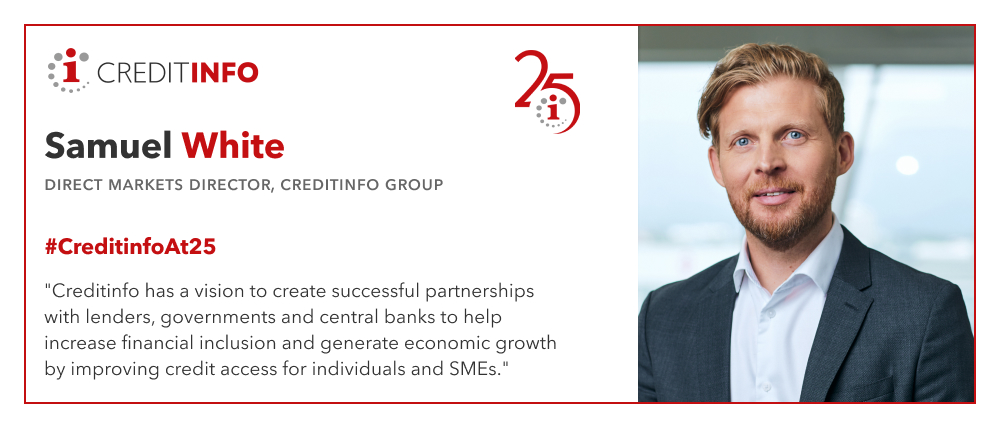
We sat down with our Direct Markets Director at Creditinfo Group, Samuel White, to discuss some of the key trends that will shape banking in the MENA and Asia region. These were some of his thoughts:
New market players from non-traditional lenders such as telco or payment providers
We are seeing an increasingly number of non-banks entering the markets. There has been a clear sign that these companies have a wealth of internal data through their platforms and usually e-wallet transactions. It has been proven that this data is extremely valuable during the risk assessment process.
SME finance
SMEs are playing an instrumental role in local economies but still struggle to receive the access to banking products in a timely fashion. In the region every country is looking at how better to serve these customers and provide them with the solutions they require.
Digital Banks, Neo Banks, Born Digital Banks
Many of the traditional lenders are based on legacy technologies and we have seen an accelerated approach to digital transformation over the last 2 years. We have also seen some banks create new digital arms to their organization setup with new technology away from legacy portfolios. These Born Digital Banks are increasing in the region, and anybody left behind can expect to lose some market share in the future.
BNPL
Buy Now Pay Later (or as some are calling it Save now pay later) is not a new concept but there is no doubt it is growing with popularity. The demand for flexible payment offerings is at an all-time high. Typically, these smaller value loans are based on impulse buying so lenders must make sure they have the process in place to offer instant decisioning.
We also asked him how Creditinfo is playing a role in shaping these trends:
How is Creditinfo helping banks lead in the digital era?
At Creditinfo we are focusing on helping banks streamline and improve the credit process across the full credit lifecycle, from origination through scoring, risk, decisioning and portfolio management. We are offering enhanced digital channels to meet the customer demands and reach the underserved or unbanked segments. We recognize it has become more accessible for individuals and SMEs to make use of digital financial services and by working with Banks we can develop software and applications to deliver services that are more transparent and automated.
What is Creditinfo’s business model and how do you see this model shaping the banking industry?
Creditinfo is a provider of credit information and risk management solutions worldwide, one of our primary goals is to help facilitate access to finance. We have built credit bureaus globally and across different markets, giving us key insights and knowledge into best practices. Creditinfo has a vision to create successful partnerships with lenders, governments, central banks to help increase financial inclusion and generate economic growth by allowing credit access for individuals and SMEs.
Creditinfo wants to continue building products and working with partners to add further solutions and data to enable lenders to further lend in a responsible fashion. Lenders are shifting their attitude towards FinTechs to keep pace with change and remain competitive. There is a huge variety of FinTech offerings available today using wide range of data that’s delivered through applications to provide lending decisions in only a few seconds.
Creditinfo Gulf and Tech Access Strategic Partnership

Creditinfo Gulf and Tech Access joined forces and announced a strategic partnership to enhance risk assessment and facilitate access to finance in the MENA region.
Both companies will help Lenders and Tech firms streamline the risk assessment process and increase credit quality, earnings and growth while mitigating credit risk.
Creditinfo is a leading service provider for credit information and risk management solutions worldwide. It has established more than 33 credit bureaus in mature and emerging markets over 4 continents, thus tangibly contributing to growing and strengthening economies.
Tech Access has become an acknowledged industry leader in the ICT enterprise distribution market in the MENA region. Providing technology solutions to large Govt., private and public corporations across UAE, KSA, Pakistan, Levant & Africa regions.
“Our partnership, comprised with Creditinfo Gulf, is to enhance our local and regional coverage on credit information and fintech service provider across the globe, offering cutting-edge analytical tools and software solutions for the financial industry for efficient credit risk and strategic decision making” commented Jawwad Rehman, CEO Tech Access.
“This announcement marks another significant milestone, and we are excited to start this new partnership with Tech Access to provide full potential of intelligent information, software and analytics solutions. Supported by international know-how and local market support, setting a remarkable high bar in the MENA region. We look forward to working with Tech Access and Financial Lenders to deliver these capabilities.” commented Gary Brown, Managing Director Creditinfo Gulf
Ends.
Creditinfo awarded contract as the service provider for the Credit Information System of Seychelles

Creditinfo to establish a new Credit Information System for the country.
London, UK – 11th January 2022: Creditinfo Group, the leading global credit information and decision analytics solutions provider, today announced that it has signed a contract to design, implement and support a new Credit Information System (CIS) for the Central Bank of Seychelles (CBS).
The contract – which will see Creditinfo’s solution rolled out over the next 12 months – makes CBS the 10th central bank to procure a credit information solution from the company.
At the end of 2020, the Seychelles population stood at 98,963, out of which there were approximately 20,099 active retail credit consumers. Seven commercial banks, all licensed and regulated by CBS, are currently the main institutions granting credit facilities to customers. A local credit union and two micro-finance institutions, also supervised by CBS, are the other major providers of credit facilities.
One of the recommendations in Seychelles’ Financial Sector Development Implementation Plan adopted in 2014 was the need to enhance the effectiveness of the existing CIS operated by CBS, inclusive of broadening the scope for the capture of information across all relevant credit providers. In this context, CBS initiated a tender process in April 2021, inviting credit information solutions providers to submit proposals to develop and implement a new CIS. The contract has ultimately been awarded to Creditinfo.
The solution will include scoring, benchmarking, and the implementation of external data sources. Creditinfo will also provide training, consultancy and ongoing support services for the management of the system over the next five years to ensure that CBS employees, local lenders and data providers have the necessary knowledge to make the new CIS a successful endeavor.
Once established, the new CIS will support existing lenders and, over time, onboard other credit data providers, including fintech companies, state-owned enterprises, hire purchase providers, credit sales and financial leasing companies, insurance companies, amongst others. Hence, the new and expanded CIS will support the incorporation of additional data to supplement traditional sources and ultimately provide more individuals and businesses with the financing needed to realize their goals and grow the economy. In addition, the enhanced system will assist the overall mitigation of credit risk.
Samuel White, Regional Director at Creditinfo commented: “While the Central Bank of Seychelles currently has a credit information system in place, it doesn’t meet the market needs of today, and certainly doesn’t enable it to realize the future ambitions of the country and its economy. We’re delighted to win this tender to put in place the technology and knowledge base to help open doors for individuals and small and medium-sized enterprises by increasing access to credit.
We see huge untapped potential in the market, and we are excited to work with our 10th central bank customer to establish a credit information system fit for the future. Once operational, this new system will enable more responsible lending by empowering local credit providers with the data they need to ensure they manage lending risks appropriately, ultimately boosting access to finance for individuals and small businesses.”
Caroline Abel, Governor, Central Bank of Seychelles, said: “Seychelles has a vibrant financial services ecosystem, and access to credit is an important aspect as we look to boost financial inclusion in the market and look at ways to grow our economy. At the same time, lenders should have access to appropriate data to have a better overview of the creditworthiness of borrowers, be able to assess credit risks and make sound financial decisions. Information collected through such a system can also be used for analysis and monitoring in the areas of financial inclusion and stability.
The CBS is therefore looking forward to the collaboration with Creditinfo over the next five years to have a modern credit information system that is in line with industry standards, ultimately assisting the development of the credit environment and overall financial sector.”
Paul Randall, CEO of Creditinfo Group added: “Creditinfo has been effective in strengthening the financial infrastructure in numerous countries across the world, and working with central banks to create a robust and fair way to assess risk and credit affordability. We are looking forward to supporting the Central Bank of Seychelles with their implementation of a future-looking credit information solution and widening access to the information and financing that will be key to future business and economic growth in the country.”
-ENDS-
About Creditinfo
Established in 1997 and headquartered in London, UK, Creditinfo is a provider of credit information and risk management solutions worldwide. As one of the fastest-growing companies in its field, Creditinfo facilitates access to finance, through intelligent information, software and analytics solutions.
With more than 30 credit bureaus running today, Creditinfo has the largest global presence in the field of credit risk management, with a significantly greater footprint than competitors. For decades it has provided business information, risk management and credit bureau solutions to some of the largest lenders, governments and central banks globally – all with the aim of increasing financial inclusion and generating economic growth by allowing credit access for SMEs and individuals.
For more information, please visit www.creditinfo.com
Media Contacts:
Matt Silver
Babel PR for Creditinfo Group
+44 (0)20 7199 3997
Creditinfo awarded license to become Malta’s first Credit Bureau

Creditinfo Malta will help local credit providers take a more intelligent approach to risk and boost financial inclusion.
London, UK – 21st December 2021: Creditinfo Group, the leading global credit information and decision analytics solutions provider, today announced that its Maltese business has been granted the license to act as a Credit Reference Agency, officially recognizing the Creditinfo Malta as the first licensed credit bureau in Malta.
This license will enable the company to launch a credit scoring system for Malta, and collaborate with local banks and lenders to create dedicated scoring products and strategies, tailored to their needs and risk appetite.
Consumers and SMEs in smaller markets like Malta are less likely to obtain financing than those in larger market with more established financial infrastructure, due to lack of information about their credit history. A credit reporting system – like the one Creditinfo is putting in place – helps to provide the information on borrowers and their financial situation lenders need to derisk the system and give them the confidence to widen access to financing.
The deal, which will see Creditinfo play an increasingly important role in the Maltese market, strengthens the company’s relationships with two key local authorities, the Malta Business Registry and the Malta Financial Services Authority, who are equally invested in growing the Maltese economy and boosting financial inclusion.
Clifford Debono, Country Manager of Creditinfo Malta commented: “A formalized credit reporting system in Malta should help open doors for small and medium-sized enterprises that have long been closed, by increasing access to credit. That will in turn enable them to grow, create jobs and benefit the overall economy.
“We see huge untapped potential in Malta, and we’re excited to establish the country’s first ever credit bureau, which will be a key driver of digitalization in Maltese financial services., ultimately boosting access to finance for individuals and small businesses.”
Paul Randall, CEO of Creditinfo Group added: “Creditinfo has been effective in strengthening the financial infrastructure in numerous countries across the world. We’re looking forward to seeing how the local lending landscape develops as we roll out our market leading credit bureau solution in Malta, derisking the financial system and widening access to the financing that will be key to future business and economic growth in the country.”
Ends
About Creditinfo
Established in 1997 and headquartered in London, UK, Creditinfo is a provider of credit information and risk management solutions worldwide. As one of the fastest growing companies in its field, Creditinfo facilitates access to finance, through intelligent information, software and analytics solutions.
With more than 30 credit bureaus running today, Creditinfo has the largest global presence in the field of credit risk management, with a significantly greater footprint than competitors. For decades it has provided business information, risk management and credit bureau solutions to some of the largest, lenders, governments and central banks globally – all with the aim of increasing financial inclusion and generating economic growth by allowing credit access for SMEs and individuals. For more information, please visit www.creditinfo.com
Media Contacts:
Matt Silver
Babel PR for Creditinfo Group Creditinfo@babelpr.com
+44 (0)20 7199 3997
Edwin Urasa appointed new CEO of Creditinfo Tanzania

New CEO Creditinfo Tanzania
Press Release
London, UK.
30/11/2021
Creditinfo Group is pleased to announce the appointment of Mr. Edwin Urasa as new CEO and Executive Director of Creditinfo Tanzania effective 01st November 2021. He is replacing Mr. Van Reynders whose tenure ended in April 2021.
Edwin brings 10 years of experience from the local banking industry having spent significant time around credit and risk management, recently before joining he was responsible for the Retail and Micro-SME segment at NBC Bank as Head of Retail Credit.
“I am especially excited to join Creditinfo Tanzania, which has been in operation for the last 9 years and has over the years continued to grow rapidly enabling small to large organizations effectively manage risk and support the government and banking community providing responsible lending in Tanzania. I am looking forward to expanding the companies’ product portfolio and services through application of best practices while leveraging Creditinfo global knowledge and expertise”.
“We are very excited to have Edwin Urasa join us as the new Creditinfo Tanzania CEO. With his vast knowledge and experience in the Tanzanian banking and credit industry, we have no doubt that he will lead Creditinfo Tanzania to greater heights and move the company’s journey forward in pushing our innovative solutions to the Tanzania market as well as pushing one of our core pillars – financial literacy, to the public at large”, says Paul Randall, CEO of Creditinfo Group.
Edwin holds a Bachelor Degree in Commerce (Hons), Majoring in Finance from the University of Dar es Salaam, an MBA from Edinburgh Business School at Heriot-Watt University-UK and has also several certifications namely, a Mortgage advisor (CeMAP)-UK, Modules in Commercial Credit from Moody’s Analytics-USA, and Risk Management from City University -UK.
ENDS.
PR contacts:
Marketing Manager/ PR for East Africa
Phidi Mwatibo
Email: Phidi.mwatibo@creditinfo.com
Average pay for women grows in Lithuania

The average pay for women has grown in 56 sectors after starting releasing information on gender pay gap. Within a matter of three months women’s average monthly pay increased by EUR 20, compared against an EUR 15 increase for men.
After Sodra (Lithuanian Social Security Authority) started publishing sectoral data on average gender pay gap, women’s average pay has grown in 56 sectors out of 81 within the past three months. Women’s monthly average pay increased from EUR 2 to EUR 325 in various sectors. In 13 sectors women’s pay grew by over 10% despite some economic activities where gender pay gap continued to grow for men, these are: insurance, re-insurance, pension accumulation companies, power generation, gas and air conditioning companies, and the pharmaceutical industry.
According to the analysis conducted by Creditinfo Lithuania, from April to July women’s average pay grew from 0.1% to 36.1%, or from EUR 2 to EUR 325 per month. In thirteen business sectors, women’s pay increased by over 10%, with the most remarkable growth reported in accommodation (16.8%), catering and supply of beverages (21.6%), gambling or betting industry (36.1%).
An increase from 10 to 14% in women’s average pay was reported in leather production and water transport, postal and courier activities, organisation of travels, sports activities, and events management, as well as several other sectors, manufacturing of coke and refined petrochemicals, cinema and television programme production, wastewater treatment, programme production and broadcasting, manufacturing of chemicals, extraction of oil and gas.
However, from the already listed sectors only in two of them (postal and courier services, oil and gas extraction) women’s average pay is higher than men’s amounting to EUR 1,856 (cf. men’s pay of EUR 1,552) and EUR 2,851 (cf. men’s pay of EUR 2,248), respectively; whereas in all the other sectors men earn more than women on average.
An average men’s pay is EUR 185 higher than women’s, but the gender gap has been narrowing
Despite the narrowing gender pay gap reported from April to July, in Lithuania men used to earn EUR 185 more than women: men’s average pay currently stands at EUR 1,596 against EUR 1,411 for women. Last April the gap reached EUR 190, with men’s average pay standing at EUR 1,581 against women’s EUR 1,391.
Aurimas Kačinskas, CEO of Creditinfo Lithuania, notes that in the absence of a more in-depth analysis, it is not feasible to assess gender pay gap; examination must be made into the types of positions held by men and women in order to identify the reasons behind differences in salaries.
“Publication of average pay is yet another indicator which can be used by future employees or partners to assess companies; knowledge of this information encourages a better understanding and awareness of the specificities of every company”, A. Kačinskas said.
The gap continues to grow in insurance, reinsurance, financial and telecommunication services, and pharmaceutical industry
Against the background of growing women’s average pay in most of the sectors, in 22 economic sectors the gender pay gap is widening. An average women’s pay dropped by 17.9% in insurance, reinsurance, and pension accumulation sector, where men earned EUR 3,179 per month on average compared to EUR 2,284 earned by women. A gender pay gap widened further from 11.1 to 11.5% in research and technical activities, pharmaceutical industry, power and gas supply, and air conditioning.
Gender pay gap continues to enlarge in the beverages’ industry, immovable property, construction of buildings, telecommunications, and financial sectors.
For instance, in telecommunications an average monthly women’s pay in July stood at EUR 1,602 compared against EUR 2,154 for men, in the financial sector these figures were EUR 2,433 and EUR 3,620, respectively.
The yawning gender pay gap is reported in air transport, where men earn EUR 3,932 per month on average, compared with women’s average monthly pay of EUR 2,385. Human resource management experts put this gap down to a higher number of men engaged in the aviation sector in better paid positions of pilots, whereas women work as flight attendants.
Meanwhile, it is worth mentioning that over three months the number of economic sectors with women earning more than men grew from 9 to 11. The sectors of education, libraries, land transport and transport via pipelines, social work, care services, furniture production, postal and courier services, tobacco and metal production were recently joined by fisheries and aquaculture companies, and motor vehicle manufacturing.
Earlier last June it was reported that, as of last April, out of 81 economic sectors in as many as 72 men receive higher pay than women.
For more information please contact:
Aurimas Kačinskas, CEO of Creditinfo Lithuania, (aurimas.kacinskas@creditinfo.lt; +37061810110).
Lithuanian corporate immunisation level is as high as 90% while others are below 30%

The share of immunised staff in different commercial companies may vary several times, the survey by Creditinfo Lithuania suggests. According to Statistics Lithuania (SL), the least immunised retailers (from 36.9 to 52%) work at markets and kiosks. The largest proportion of immunised staff after vaccination (up to 74.7%) has been reported in pharmacies, optics and supermarkets. Among all the sectors, the least active are construction and transport companies, but this indicator may well be explained by a large share of foreign nationals on their staff list.
According to SL data, in terms of the share of immunised staff in the commercial sector, companies selling bread, buns and confectionaries in specialty bakery shops take the last place, with slightly over one third (36.9%) of immunised staff. In other commercial segments, the percentage of fully immunised staff is within the range of 52–64%, with 60–87.2% of staff having received at least one vaccination doze.
Jekaterina Rojaka, Head of Business Development and Strategy at Creditinfo Lithuania, says that after the Statistics Lithuania launched publication of immunisation indicators on a company level, Creditinfo followed suit and started reflecting them in its information systems, while a growing number of users look for information on immunisation of potential business partners.
More staff got infected and recovered from the virus where the vaccination pace is slow
It appears from the publicly available data that in companies with staff delaying vaccination the proportion of staff infected or having recovered from the virus is higher. Obviously, the analysis of recovery indicators among staff suggests that many of these people (up to 12%) are among market and kiosk retailers. Within the category, the sub-category of textile, clothing and footwear retailers stands out where the full immunity (two vaccine dozes) within this group has been acquired by 52% of staff, another 12% of staff became immune after getting infected and recovering from the virus, bringing the overall immunisation level to 64%.
In comparison to workers in supermarkets, pharmacies and optics with 75% of fully vaccinated staff, the immunity after getting infected with the virus was reported from 1 to 5% of the labour force.
The largest number of immunised staff work for the financial services sector, the smallest number – in transport companies
The analysis of companies from other economic sectors suggests that among companies with 70–100% of immunisation level, those engaged in financial activities and services take the lead with 87.1% of immunised staff. Companies at the bottom of this group are from construction (38.7%) and transport sectors (30.3%). According to J. Rojaka, a low level of vaccination there may be explained by a relatively high number of foreign staff working in these sectors, leaving their immunisation indicators outside the scope of the national statistics.
Compared to other economic sectors, extractive industry and agricultural companies are moving at the slowest pace towards the set immunisation target of 70–100%, accounting for 46.6 and 47.8% of immunised staff, respectively.
In restaurants and hotels, which had been very actively promoting vaccination among their staff, at the end of August the immunisation indicator approached to 71.5 and 71.6%, respectively. J. Rojaka notes that these two sectors have achieved the major quality progress in terms of staff vaccination pace, reporting an increase of 45 percentage points in the number of staff vaccinated in August.
For more information:
Jekaterina Rojaka,
Head of Business Development and Strategy, Creditinfo Lithuania
Email: jekaterina.rojaka@creditinfo.lt;
Tel: +370 612 73515